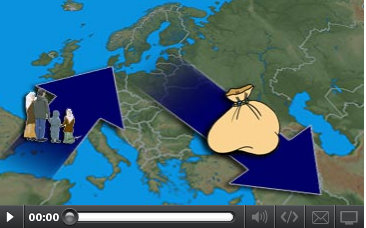
En dramadokumentarisk hyldest til Orwell på 100-års dagens for hans fødsel i 2003. Selvom Orwell arbejde på BBC fra 1941, findes der mærkeligt nok hverken stemme- eller filmoptagelser med ham. Da jeg var helt ung, havde jeg den vane, at hvis jeg kunne lide en forfatter, læste jeg hver linje han havde skrevet. Ingen highlights og potpourrier. Det samme med Orwell, der også har skrevet mindre gode romaner, skal man vide. Jeg læste The Collected Essays Journalism and Letters of George Orwell i fire tykke Penguin bind, 1200 sider, og forsøgte mig endda med oversættelser, en lidt stor mundfuld for en 17-årig gymnasiast. Det var hele i 1969, hvor han endnu ikke var outed af venstresnoede gymnasilærere, som jeg hører han – “anti-kommunisten”, så var man allerede halvvejs en McCarthyist i de forrykte år, – kunne være i firsernes gymnasium. Hele læseriet tog trekvart år. Her tager det halvanden time. – Denne film blev flot anmeldt, da den kom. Den er også rigtig god, mere dokumentar end drama. Den indeholder adskillige filmklip med mennesker, der kendte den unge Orwell, da han var down and out. Som kendte den midaldrende, og som kendte hans kone Eileen, der døde i 1945, og gjorde ham “desperately alone” indtil ægteskabet med Sonia Brownell det allersidste år.
In the future, we shall abolish the orgasm. Our neurologists are at work upon it now. There will be no loyalty, except loyalty towards the Party. There will be no love, except the love of Big Brother. There will be no laughter, except the laugh of triumph over a defeated enemy. There will be no art, no literature, no science. There will be no curiosity, no enjoyment of the process of life. All competing pleasures will be destroyed. But always— do not forget this, — always there will be the intoxication of power, constantly increasing and constantly growing subtler. Always, at every moment, there will be the thrill of victory, the sensation of trampling on an enemy who is helpless. If you want a picture of the future, imagine a boot stamping on a human face— forever. The moral of this, is a simple one. Don´t let it happen. 1984 (1949)
All writers are vain, selfish, and lazy, and at the very bottom of their motives there lies a mystery. Writing a book is a horrible, exhausting struggle, like a long bout of some painful illness. One would never undertake such a thing if one were not driven on by some demon whom one can neither resist nor understand. For all one knows that demon is simply the same instinct that makes a baby squall for attention. And yet it is also true that one can write nothing readable unless one constantly struggles to efface one’s own personality. Good prose is like a windowpane. I cannot say with certainty which of my motives are the strongest, but I know which of them deserve to be followed. And looking back through my work, I see that it is invariably where I lacked a political purpose that I wrote lifeless books and was betrayed into purple passages, sentences without meaning, decorative adjectives and humbug generally. Why I write (1946)
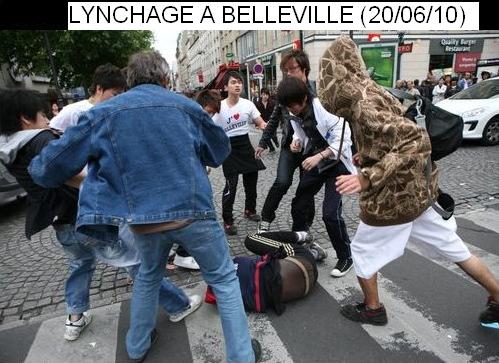
Lynchning i Belleville
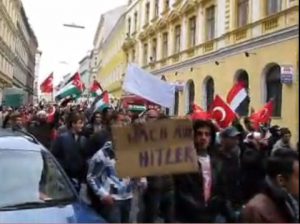
En afrikansk tasketyv har fejlbedømt situationen. Det gik hårdt for sig forleden, da op imod 10.000 kineresere i Paris havde fået nok. Online ses det ikke, at danske medier har omtalt demonstrationen og de efterfølgende uroligheder. Chinesische Selbstjustiz in Paris Belleville
“Apokalypse” i Paris efter algiersk fodboldnederlag
A late goal by Landon Donovan of the U.S. resulted in the elimination of Algeria as a contender for the Cup. Several news sources carried reports of the acts of violence. 20 Minutes.Fr.:
There were incidents on Wednesday in and around the Charléty stadium in Paris, where the soccer match was being broadcast live, according to police sources. After the defeat by the United States (0-1), the manager of a garage located near the stadium told 20 Minutes: “It was an apocalypse: several thousand persons marched in front of my establishment. The police charged. I had to make women and children go inside. Twenty young persons stole tires, broke car windows; at least four cars were burnt in the street,” he went on. “A car belonging to one of my customers is no longer usable – they turned it upside down,” he says, in a state of shock. The Disqualified and the Unqualified
Holland og Belgien: Kriminalitet og etnicitet
Islam in Europe har oversat en artikel fra Gazet van Amsterdam om en ny undersøgelse i TIJDSCHRIFT VOOR CRIMINOLOGIE: Criminaliteit, migratie en etniciteit, 2010, (52)2,
In the Netherlands, half the Moroccan youth get in trouble with the police by the time they’re 22. A third of this group are repeat offenders with more than 5 incidents on their record, according to a new study published in the recent issue of the Tijdschrift voor Criminologie (Journal of Criminology).
To the surprise of the authors, it turns out Moroccan girls commit three times as many crimes as Dutch girls. And multiple offenders are on average not more violent than people who commit a crime every now and then. According to another study in the same issue of TVC, asylum migrants commit more crimes than ethnic Dutch or regular migrants. An evaluation of of both studies, and the question is whether this study can be generalized for Belgium. Not so.
The link between ethnicity and studying criminality is a sensitive issue. Registration of somebody’s ethnic background soon brings charges of ‘racism’. In Belgium there are no studies about this issue, but in the Netherlands there are. TVC devoted an entire issue to this subject.